Send us a message

"*" indicates required fields

This field is for validation purposes and should be left unchanged.

Protecting your dream home purchase.

For Buyers

Whether you are buying a home for the first time or searching for the right home to retire in, closing on your home is the final step to becoming a homeowner. It is the moment when all of your hard work finally pays off! From extensive research to relocating your furniture, all of your steps lead to receiving the keys to your new home.

Homeland Title is different from other title companies in its approach, whether you are a buyer or seller, the experience is uniquely different. At Homeland Title we put you first throughout the process. We realize you have a choice in choosing your title company and we are glad you chose us! We commit to exceptional service by ensuring our customers are informed, close on time and close with confidence.

We provide you with every available resource for closing. Special time has been taken to develop tools to inform buyers and sellers including a closing calculator and seller’s net sheet. Use the closing calculator to discover estimated settlement charges you can expect during the closing process. The Homeland difference ensures customers are informed every step of the way.

With over 78,000+ closed transactions we understand closing in a timely manner is important to everyone involved. All documents, procedures and processes are discussed ahead of time make closings easy and timely.

Our commitment to exceptional service is well known in the industry. We specialize in accurate, thorough and detailed title and settlement services and we take pride in our ability to ensure each and every closing is prepared with the same thoughtful and careful consideration that you have put into the decision of purchasing a home. Take a moment to explore our website. We have loaded it with helpful tools and information – just like the helpful and informative staff we have available for you!


Comprehensive Approach To Property Purchases

Our comprehensive approach to property purchase settlements includes:

01

Document Preparation

Our team, including our attorneys, meticulously prepare and review all necessary closing documents for buyers and sellers, ensuring accuracy and full compliance across residential and commercial transactions

02

Title Search and Examination

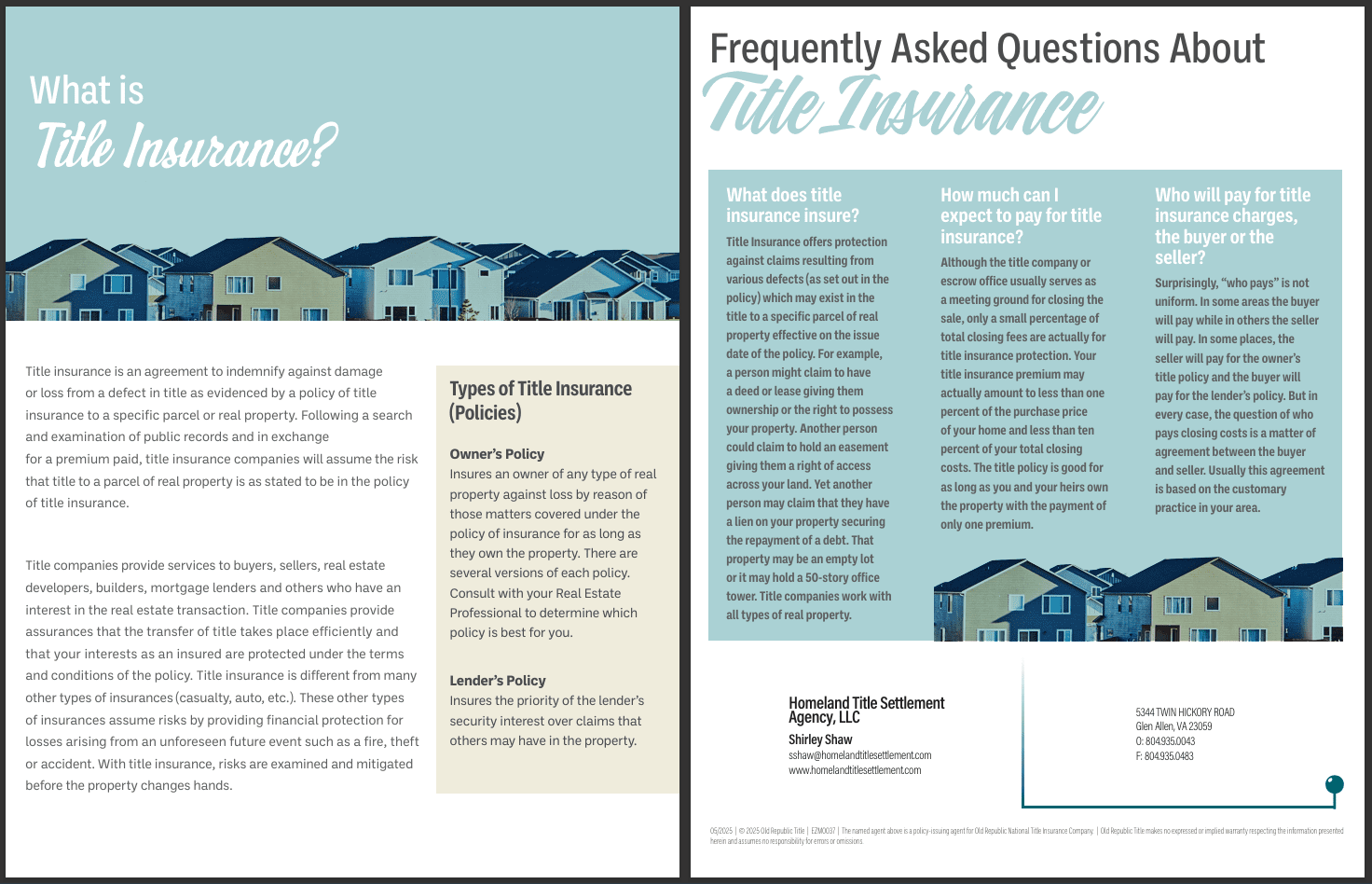
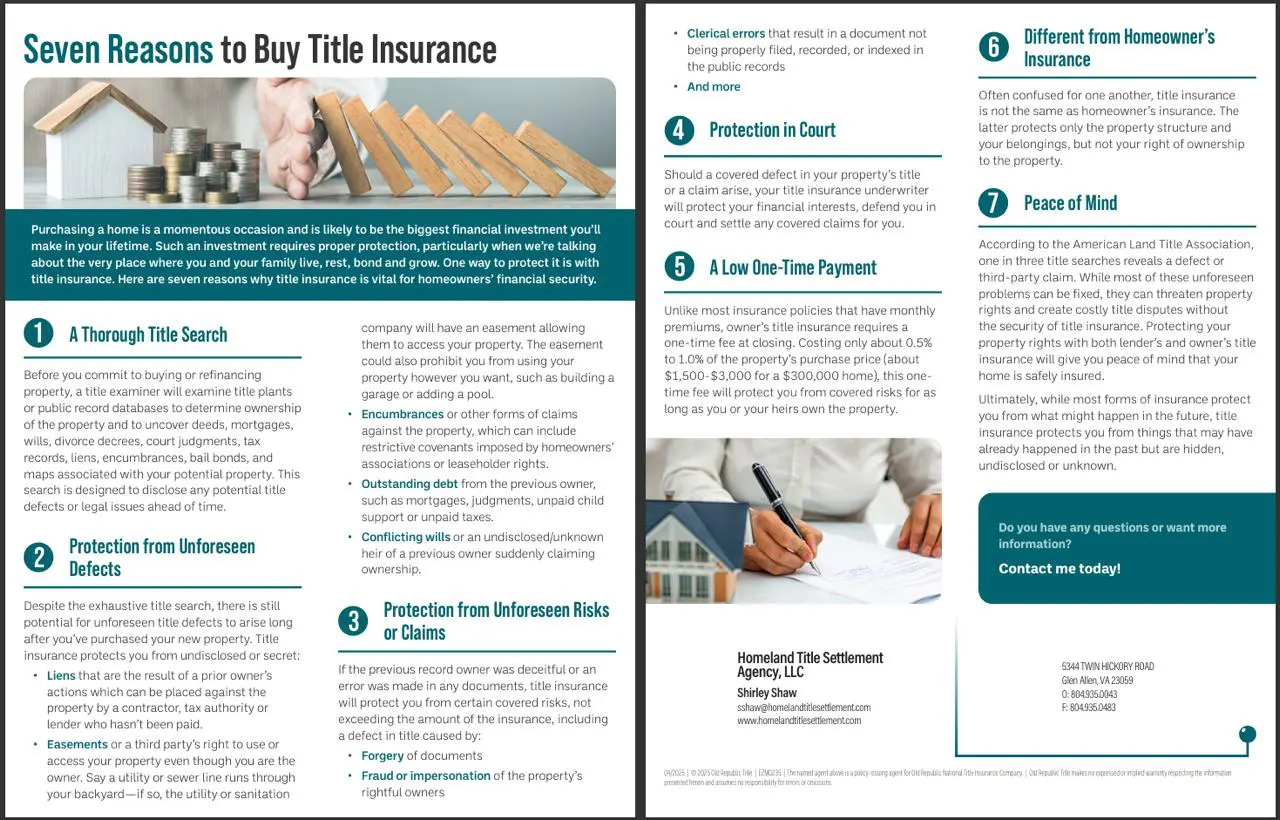
A title search and examination is a key step in a real estate transaction that verifies a property's legal ownership and checks for any issues that could affect the transfer of ownership. This is the process of reviewing public records to trace the history of the property. It looks at the past owners, mortgages, tax records and other documents to confirm that the sellers actually own the property and have a right to sell it. If issues are found, we find a solution to resolve them prior to closing.

03

Settlement Coordination

A successful closing requires careful coordination and planning. As an independent third party in the transaction, our role is to orchestrate all aspects of the closing process. At Homeland Title, our philosophy is to get involved as early as possible. This proactive approach ensures we are fully prepared to provide a smooth and positive closing experience for every client.

04

Title Insurance Underwriting

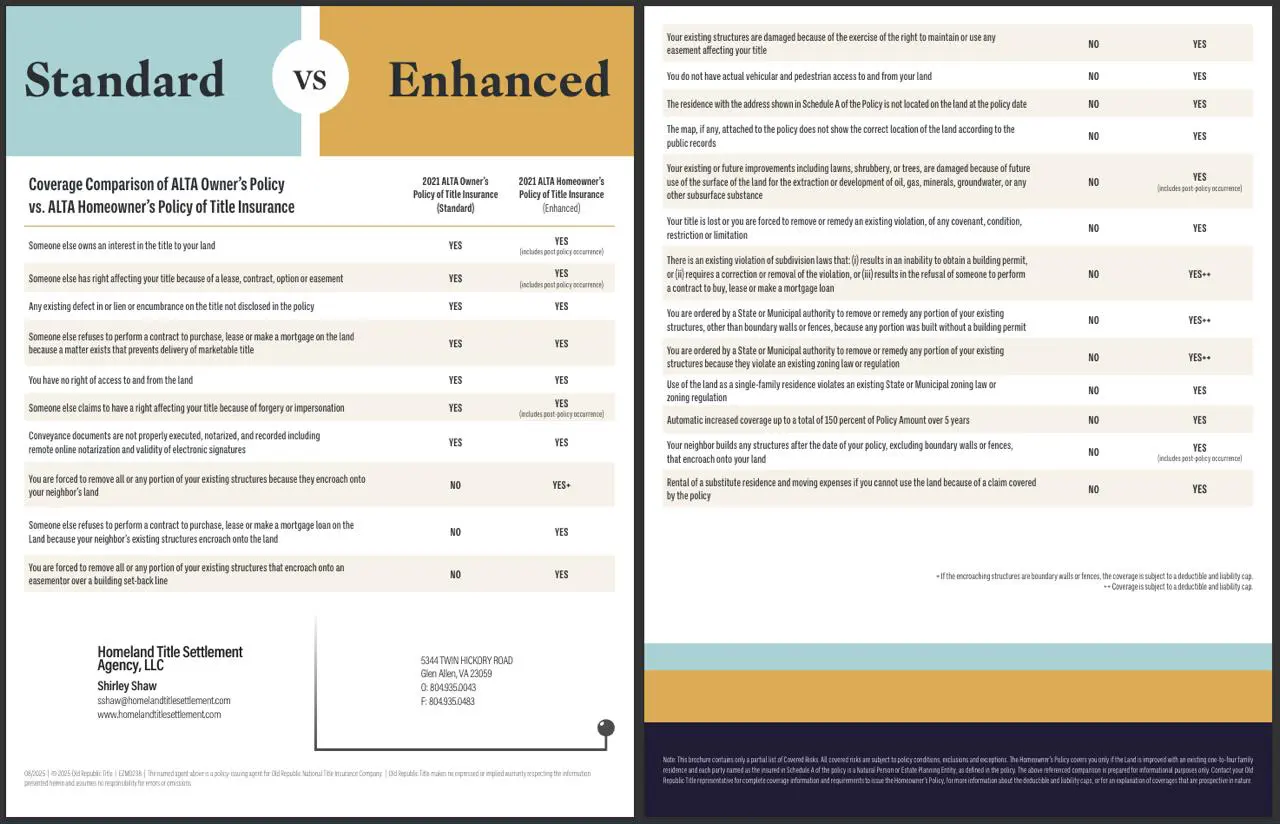
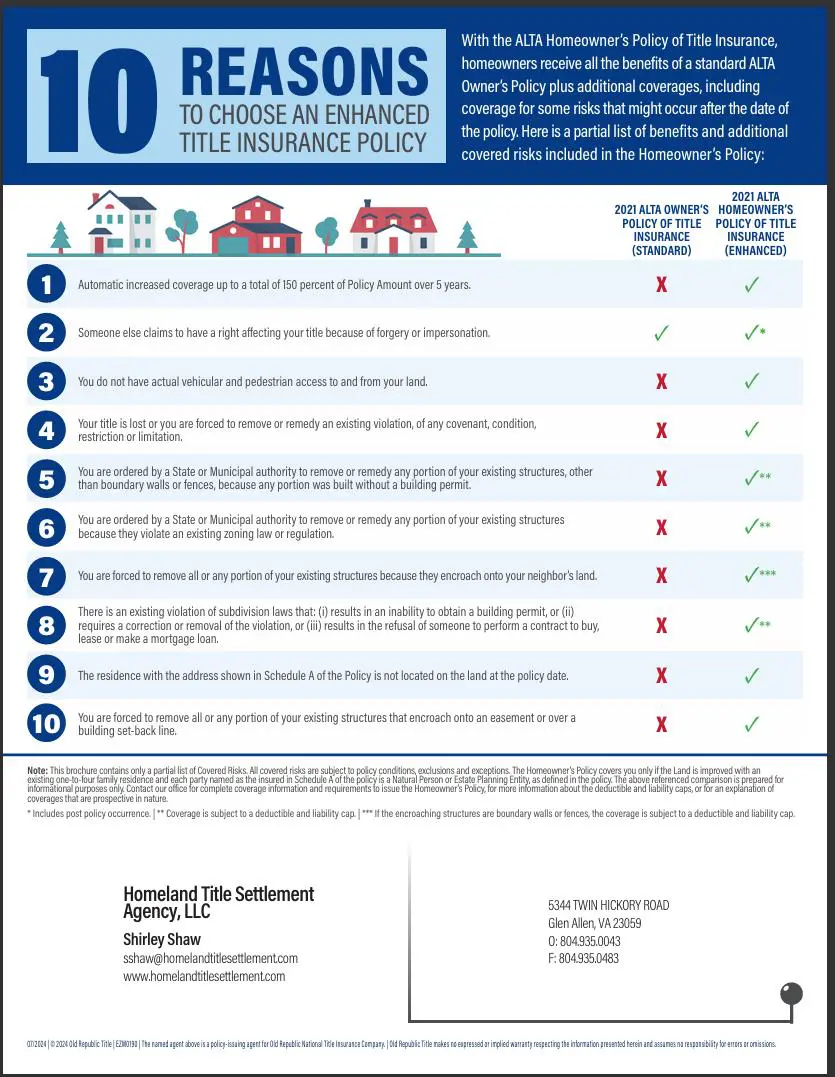
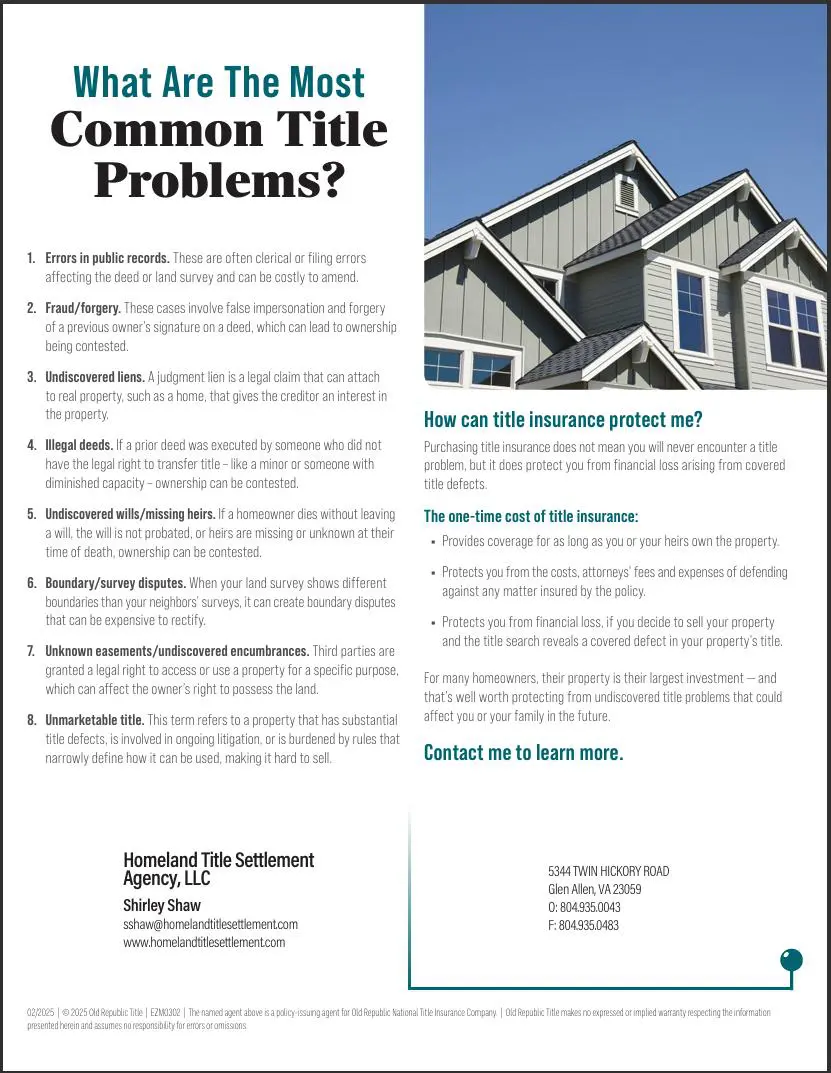
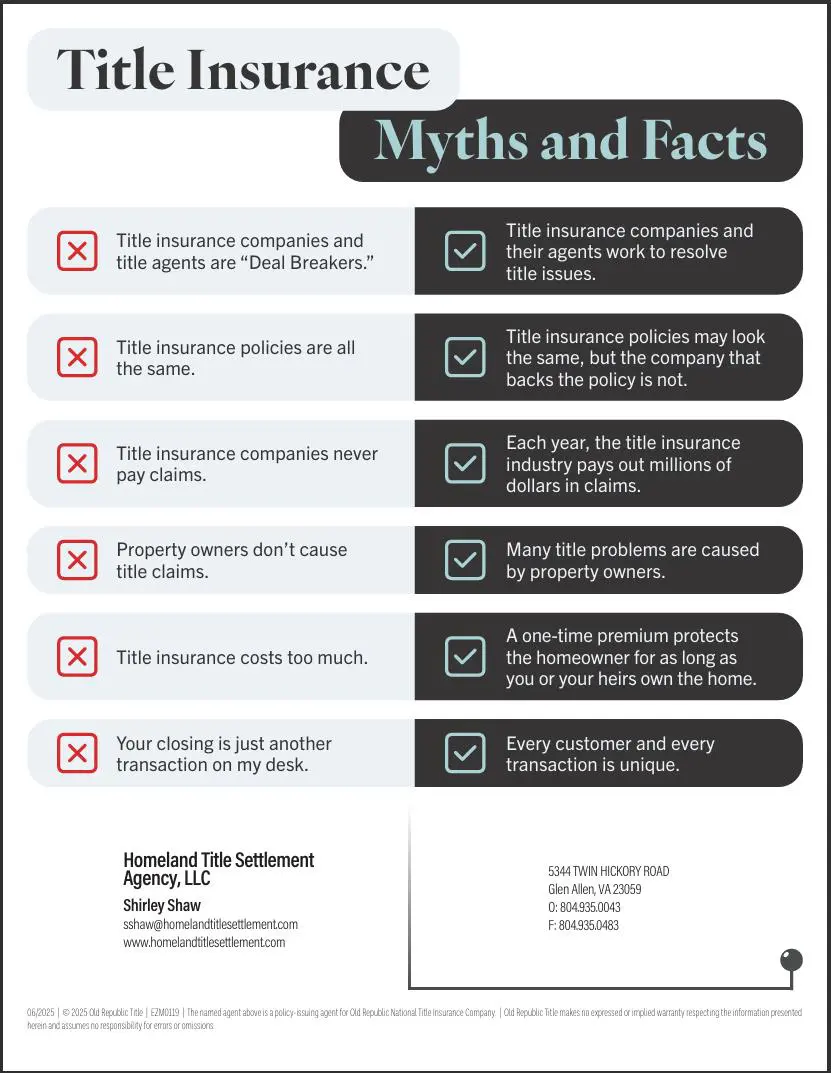
An owner's title insurance policy protects you as the property purchaser from financial loss due to defective issues with the property's title that weren't discovered during the purchase process. Unlike typical insurance which protects against future events (like a fire), title insurance protects against past events that may challenge your ownership.

05

Closing Day Management

On closing day, we will guide you through each document before you sign, handle the collection and distribution of funds, record all documents with the clerk's office and celebrate with you as you receive the keys to your new home.

4 women gathered around a desk smiling and reviewing blueprints

Extra Support When You Need It Most

First-Time Buyer Assistance

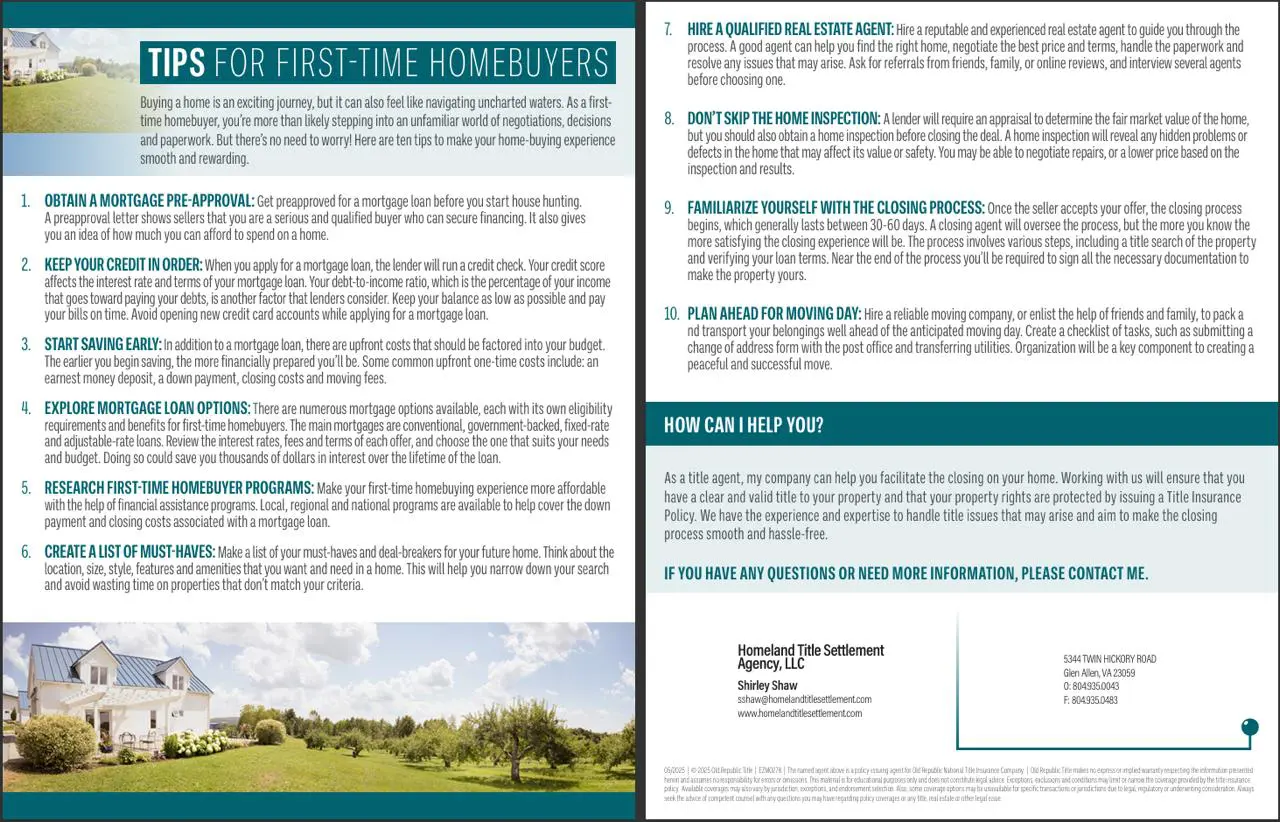
At Homeland Title, we specialize in guiding first-time homebuyers every step of the way. From the moment you sign your contract through closing day - and even beyond - we are here to answer your questions and provide clarity at every stage. We offer easy-to-understand educational resources that simplify complex terms and processes, along with a detailed closing cost calculator to help eliminate any surprises at closing.

Our team is committed to turning what can feel like an overwhelming experience into a smooth, informed, and exciting milestone on your journey to homeownership.

4 women gathered around a desk smiling and reviewing blueprints

Think Before You Click, Send or Speak.

  • Is the message or call expected?
  • Can I verify the sender or caller?
  • Does the request(s) make sense?

How To Recognize and Avoid Phishing Attacks

Don’t Get Hooked

To Avoid getting caught hook, line, and sinker, watch out for these red flags:

  1. Misspellings in the email address, subject line, or body
  2. An unexpected attachment
  3. Demand for immediate attention
  4. A link you can’t verify (hover over to check)
  5. Always call to verify before clicking an unfamiliar site

Placeholder

What Is Phishing?

Phishing is a tactic used by cybercriminals to trick you into clicking on a link or giving up sensitive information through emails, text messages and phone calls.

What Is Spoofing?

Spoofing is a tactic used where, in order to accomplish their mission, cybercriminals will also impersonate a known and trusted source. It’s very important not to take the bait!

Frequently Asked Questions

Placeholder

What is a deed?

A deed is a physical legal document used to transfer the ownership of an asset (like a house or land) to a new owner.

What should I bring to closing?

A government issued photo ID (driver’s license, passport or military ID).  A wire transfer is required for all funds due from you at closing.  We will let you know in advance if additional documents are needed.

How long does a closing take?

Purchase closings take generally 30-45 minutes, Seller signed documents take generally 20 minutes and for a refinance you can generally expect 20-30 minutes.

Can I sign remotely?

Absolutely.  We offer multiple options for closings including a traditional in person closing at one of our eight office locations, a mobile notary or remote online notarization.

Do I need an attorney to close on my new home?

No.  Under the laws of the Commonwealth of Virginia (Sections 55-525.18 and 55-525.19) a title company can process your real estate closing for you.  There are many advantages to working with a title company.  Because closings and title insurance are all we do we tend to be more flexible and accommodating to your schedule.  We can often work more efficiently and are more cost effective.

I am a first-time homebuyer. What should I expect?

How can I avoid becoming a victim of wire fraud?

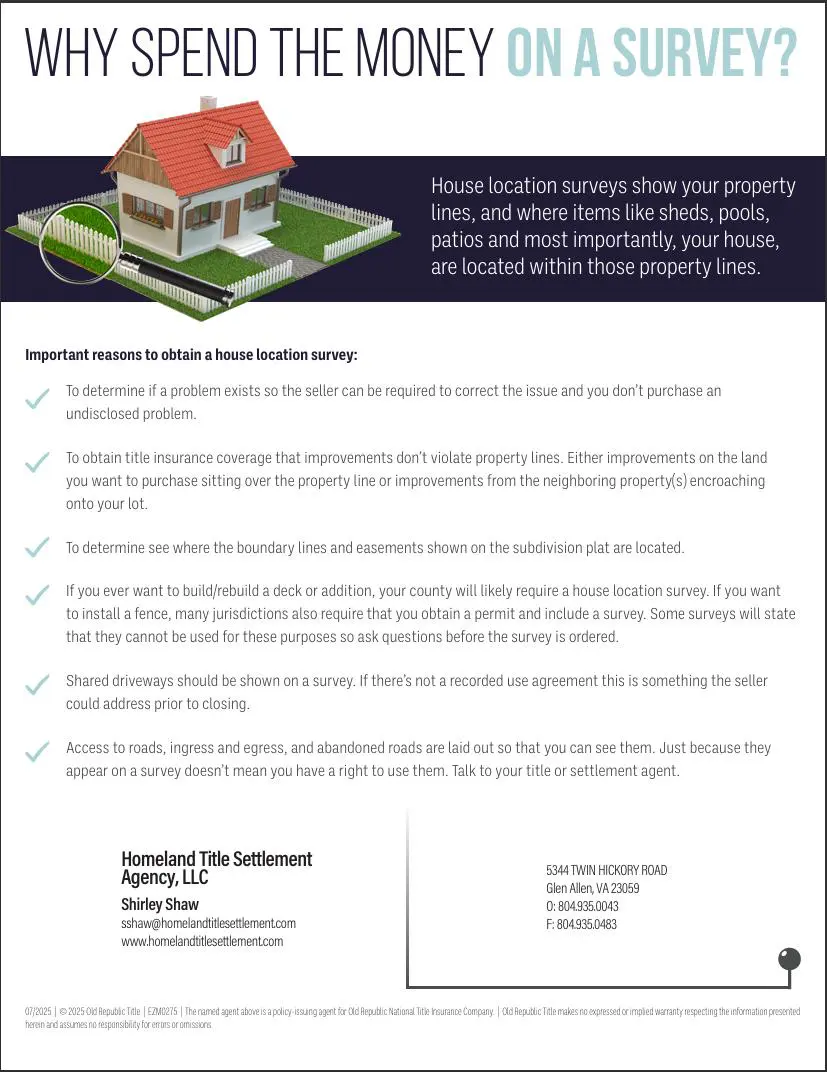
Do I need a survey?

Why should I refinance my mortgage loan?

What is an HOA?

Many properties are located in areas that are subject to protective covenants. Protective covenants outline rules and restrictions for the neighborhood or development. The goal of the covenants is to protect the integrity of the neighborhood and to preserve property values.

Covenants are generally recorded at the county courthouse, and everyone who buys property in the neighborhood after the covenants are recorded is subject to the covenants. Developers or neighbors often form homeowners associations to further the goals set out in the covenants, to collect dues from the property owners, to maintain common areas, and to enforce rules and regulations.

At closing, unpaid association dues from previous years are the responsibility of the seller. Association dues for the current year are prorated between the buyer and seller. Future dues are the responsibility of the buyer, and future dues are not typically held by the lender in an escrow account.

What is an Escrow Account?

An escrow account contains funds held by a lender for future payment of property taxes and applicable insurance, such as homeowner/hazard insurance, flood insurance, and/or mortgage insurance Private Mortgage Insurance . Lenders utilize escrow accounts to ensure that the loan collateral is protected from losses resulting from tax sales for unpaid taxes or lack of insurance coverage due to unpaid premiums.

At closing, taxes for the current year are pro-rated, and the buyer pays up-front for a homeowners insurance policy for one year. The closing attorney or settlement agent establishes the escrow account on behalf of the lender to pay future tax bills and insurance renewals.

The lender does not pay interest on the funds held in escrow, and the lender does not charge a fee to manage the account. Lenders analyze the escrow account annually to prevent holding too much money, and the amount a borrower pays into the account each month can change to avoid accumulating overages or shortages.

The lender will generally calculate the tax escrow based on the tax bill used for prorations at closing. Sometimes, however, the tax assessment used for proration purposes is obviously much lower than future tax assessments will be – for example, cases where prorated taxes were based on unimproved property, or prorated taxes were calculated with exemptions no longer applicable for the new buyer. In such cases, the closing agent will calculate an estimated future tax bill based on formulas set forth by the taxing authority. The estimated future tax amount is then used to establish the escrow account.

Insurance escrows are based upon the known guaranteed renewal premium. If a renewal premium is not known or guaranteed, the escrows will be based on the annual premiums for the current year.

At closing, the settlement agent makes an initial deposit into the escrow account to set it up. The borrower then continues to make ongoing monthly deposits into the account with each monthly mortgage payment. When taxes or insurance renewal premiums become due, the account will pay out these items, and a cushion remains in the account going forward.

What are Real Estate Taxes?

Property owners are obligated to pay city, county, and/or state ad valorem taxes. Nonpayment of such taxes will result in a lien on the property. The county tax assessor periodically determines the value of the property, and taxes are assessed on the appraised value of the property. Depending on the city, county and/or state in which the property is situated, there may be exemptions for which the property owner can apply which reduce the tax bill.

At closing, the seller is responsible for paying delinquent property taxes for previous years. Taxes for the current year are prorated between the buyer and seller on the settlement statement. Generally, the lender requires the settlement agent to establish an escrow account to pay taxes for future years.

In calculating taxes for closing, settlement agent will base prorations upon the current year’s tax bill. If the tax bill for the current year has not been issued, the proration of taxes will typically be based upon the previous year’s tax bill. The amount of the charge to one party and the credit to the other is determined by dividing the annual tax bill by 365 (for the daily amount) and then multiplying that amount by the number of days before closing (for the seller) and after closing (for the buyer).

In closings involving new construction, the current tax bill may be dramatically less than future tax bills are expected to be. This happens because the most recent tax assessment was likely based on unimproved property. The tax assessor will eventually reassess the property and base taxes on the improvements. In such cases, the settlement agent will use the current lower tax bill for prorations between the buyer and seller, and the closing agent will use an estimated future tax amount to establish the escrow account.

Your Questions Answered

At Homeland Title, we believe an informed client is confident.

Looking To Talk To Someone?

Have more questions, or want a personal conversation?

804.935.0043

Get Your Free Quote Today

Take the first step toward a stress-free closing experience.
Contact our team for a customized quote tailored to your specific real estate transaction.

79,800

Over 79,800 Happy Clients And Counting!

From the moment you choose Homeland Title Settlement Agency, you can trust that you're in capable hands. 
We aim to ensure a smooth closing experience, whether you're purchasing your dream home or expanding your investment portfolio.

Partner with us and experience the difference between working with a dedicated team that puts your needs first. Welcome to a seamless world of real estate transactions with Homeland Title Settlement Agency.

Our Locations

← 200 Miles West

Blacksburg Location

117 Washington Street SW,
Blacksburg, VA 24060

Carytown

3447 West Cary Street,
Richmond, VA 23221

Chesterfield

1500 Huguenot Road, Suite 103
Midlothian, VA 23113

Mechanicsville

6372 Mechanicsville Tpke #102, Mechanicsville, VA 22222

Tappahannock

321 Queen Street,
Tappahannock, VA 22560

White Stone

410 Chesapeake Drive,
White Stone, VA 22578

Williamsburg

240 McLaws Circle, Suite 148, Williamsburg, VA 23185

West End Richmond

5344 Twin Hickory Road,
Glen Allen, VA 23059

West End Richmond, VA

View Location Details

Mechanicsville, VA

View Location Details

Chesterfield, VA

View Location Details

Carytown, VA

View Location Details

Tappahannock, VA

View Location Details

White Stone, VA

View Location Details

Blacksburg, VA

View Location Details

Williamsburg, VA

View Location Details

Get In Touch

We're committed to making your real estate transaction as stress-free as possible. Whether you have questions about our services or are ready to schedule a consultation, our team is here to help.

Contact Information

804.935.0043

Schedule A Consultation